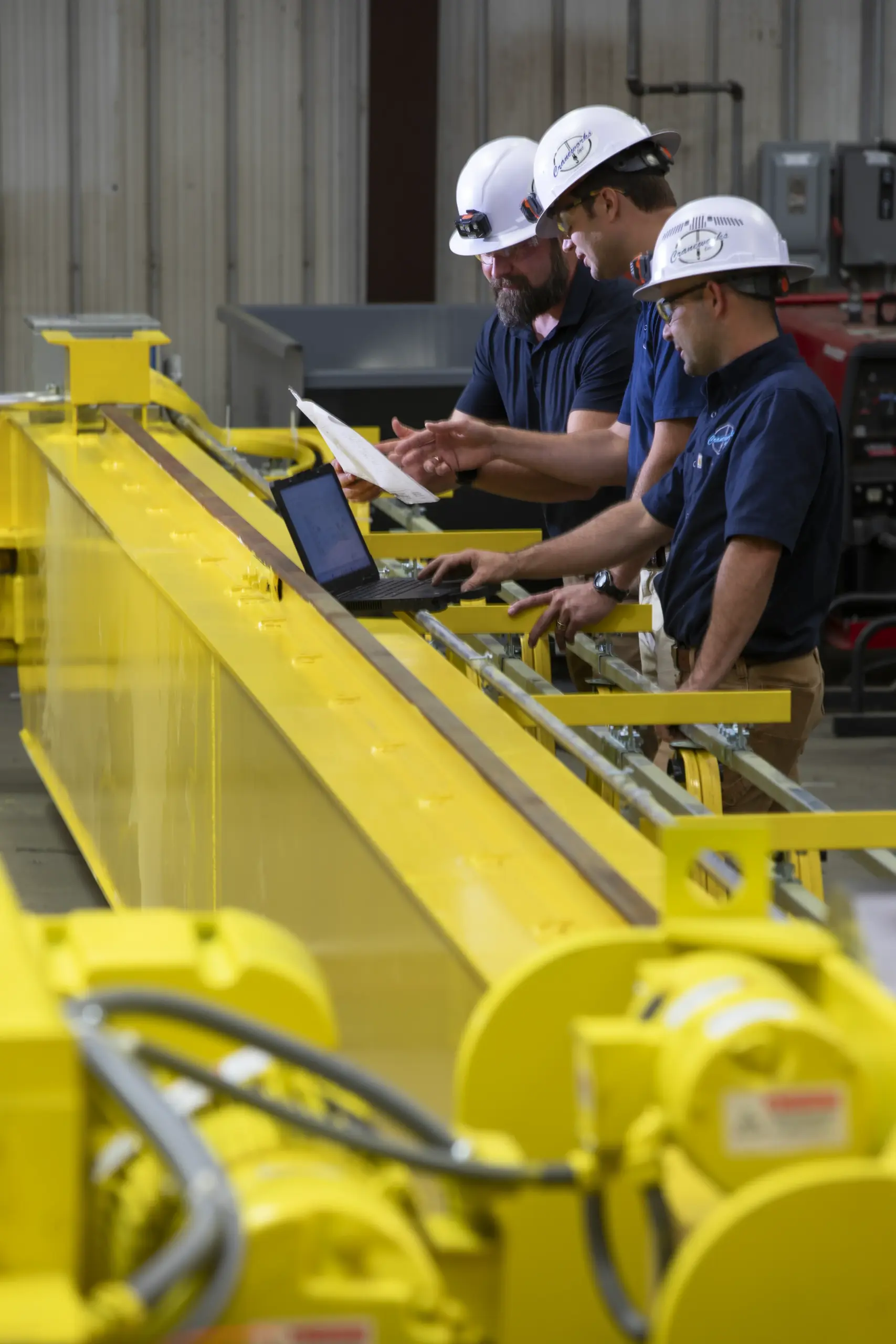
Overhead Crane Design and Manufacturing Services
We design everything from small hoist systems and bridge cranes to large-span, high-capacity cranes. We also offer specialized designs such as explosion-proof cranes for hazardous environments.

TRUSTED BY
Our Product Categories

Commercial hoists
10 tons or less
Small bridge cranes
Up to 10 tons, “Category 3” Navy cranes
Large bridge cranes
10+ tons, long spans up to ~150 feet, heavy fabricated box girders
Explosion-proof cranes
For ordnance and hazardous environments
VENDORS





WHAT MAKES US UNIQUE
Mission-Ready Designs
Extensive experience designing cranes that meet strict DOD and Navy standards and requirements.
Smart Integrations
Ability to integrate commercial off-the-shelf components into compliant systems.
Cybersecurity Safeguards
Unique expertise in cybersecurity controls for crane systems.
Our Overhead Crane Design Services
We offer program-level engineering support, including educating our government clients on documenting overhead crane requirements to ensure solicitations are written correctly and result in certifiable cranes. Examples of our design services include
Crane design
Engineering drawings
- Detailed mechanical, structural, and electrical schematics for every subsystem (girders, hoists, brakes, control panels, festoon systems, and safety devices)
- 2D and 3D layouts that show the crane envelope, hook coverage, and integration into the facility infrastructure
Structural and mechanical calculations
- Load-bearing analysis of girders, wheel loads, and trolley/hoist assemblies.
- Stress and fatigue calculations
- Brake torque and stopping distance calculations
- Gearbox, shaft, and bearing life assessments
Electrical and control system specifications
- Wiring diagrams and termination details
- Control logic, drive parameter sheets, and operator interface design
- Compliance with cybersecurity requirements for mission-critical systems
Material certifications
- Verified documentation for steel grades, fasteners, wire rope, chains, brakes, and electrical components
- Traceability for all load-bearing and safety-critical parts
Facility Design Criteria
- Maximum wheel loads, impact factors, and power demand for integration into facility design
- Load charts for safe operating capacities
Compliance mapping
- Cross-referenced documentation showing how each requirement in Navy (NAVFAC P-307), Army, OSHA 1910.179, and ASME B30 standards has been met
Crane design inputs into facility designs
- Crane envelope – the space in a facility reserved for crane equipment and avoids conflict with HVAC, plumbing, or electrical systems
- Hook envelope – the operational range of the hook
- Load requirements – supply crane wheel loads and electrical power loads for facility integration
Cybersecurity
- Analysis and documentation – for crane control systems to ensure system can be restored in the event of a cyberattack
Our Overhead Crane Manufacturing Services
Fabricate
In-house fabrication of smaller units (e.g., 2–10 tonnes, patented track, or single-girder cranes)
Partner
Collaborate with large-scale manufacturers for large bridge cranes and specialized manufacturers for explosion-proof cranes and specialized painting system requirements.
Deliver
Installation is performed per our engineered lift plans and adherence to stringent safety requirements such as EM-385 and NAVFAC P-307. After installation, acceptance testing and load testing are performed to ensure contract compliance and safe operating conditions are delivered.
Case Study: Best Value Selection – Delivering Navy-Compliant Crane Systems for Mission-Critical Aircraft Maintenance
Challenge
A Navy aviation maintenance facility needed to replace mission-critical dual-hook hoists, bridge cranes, and patented track runway systems that support aircraft maintenance and readiness operations.
Previous efforts with both local and national crane manufacturers—experienced in commercial and industrial markets—had failed to meet Navy certification requirements. Designs and submittals lacked the documentation and traceability required under NAVFAC P-307 and Navy Crane Center (NCC) standards, delaying execution and creating mission risk.
Operating under a tight downtime window, the Navy needed a partner capable of engineering, fabricating, and installing a fully compliant crane system without disrupting ongoing maintenance operations.
Solution
Craneworks was awarded a Firm Fixed-Price contract under a standalone COMFRC procurement using a best-value trade-off, emphasizing past performance and technical capability.
The project scope included:
- Replacement of two dual-hook hoists, two bridge cranes, and two patented track runway systems
- A structural evaluation of the facility to verify load capacity and establish design parameters
Craneworks developed a comprehensive solution combining engineering rigor, field execution, and stakeholder coordination to ensure mission continuity. Activities included:
Engineering and Design Compliance – Performed a full structural analysis and designed specialty hanger bracket assemblies to distribute crane loads across the limited-capacity facility structure.
User and Facility Coordination – Worked directly with end users and process owners to align mobilizations and minimize downtime, ensuring continued readiness throughout installation.
Documentation and Approval – Prepared and submitted complete crane design packages for Navy review and approval.
Cybersecure Controls – Integrated control systems meeting DoD RMF and Navy ICS cybersecurity standards.
Mission-Focused Execution – Sequenced work and mobilizations to maintain operational continuity in a live aircraft maintenance environment.
Results
- Best Value Achieved – Selected over lower-priced bidders based on superior compliance history and technical capability.
- Accelerated Schedule – Delivered in approximately half the time of a traditional NAVFAC procurement.
- Full NAVFAC P-307 and NCC Compliance – All cranes certified and operational upon turnover.
- Operational Continuity Maintained – Installation completed with minimal downtime and zero mission impact.
Why it Matters
Through a Firm Fixed-Price, best-value contract, Craneworks provided a fully Navy-compliant crane solution that restored certification, ensured mission readiness, and met stringent operational constraints.
This project demonstrated that best value selection—not low bid—delivers the lowest total risk for mission-critical Navy applications.
By integrating engineering, compliance management, and field execution, Craneworks consistently delivers certifiable, cybersecure crane systems in half the time of traditional procurement methods—supporting the Navy’s ultimate goal: safe, reliable, and uninterrupted readiness.
OUR TEAM
Meet Terry Leach
Vice President of Operations, Overhead Crane Division
Mr. Terry Leach joined Craneworks in 2010 as a Project Manager for Large Projects, where he successfully led numerous electrical modernization initiatives for cranes ranging in capacity from 10 to 550 tons.
During his tenure, he managed several high-profile programs, including an 18-month, three-crane modernization project for the U.S. Army Corps of Engineers in South Dakota.
With over 28 years of experience across multiple industries—including Defense, Nuclear, Mining, Aviation, Pulp and Paper, Coal, and Hydropower Generation—Mr. Leach brings extensive technical and operational expertise to every project.
His proficiency in overhead lifting systems spans from integrated patented track monorails to 600-ton bridge cranes.
In 2020, he was promoted to Vice President of Operations for the Mid-Atlantic and Carolina Regions, where he oversees Navy Weight Handling Equipment (WHE) programs supporting multiple military installations.
Throughout his career, Mr. Leach has designed and installed more than 160 overhead bridge cranes and hoists, demonstrating a proven track record of engineering excellence and leadership in complex lifting applications.

Cody Williams
Overhead Crane Technician
[ Read Bio ]
Garry LewisName
Overhead Crane Technician
[ Read Bio ]
James Roy
Overhead Crane Technician
[ Read Bio ]
Lauren Dubose
Overhead Crane Technician
[ Read Bio ]
Curtis Newsome
Overhead Crane Technician
[ Read Bio ]
Jonthan Hamilton
Service Manager
[ Read Bio ]
FAQ
How do you ensure your crane designs meet military and government standards?
Every design is built around compliance with Navy (NAVCRANECEN INST 11450.2 in addition to P-307), Army, OSHA 1910.179, MHIA standards (CMAA 70, 74), ANSI (MH27.1), and ASME B30 standards. We prepare comprehensive engineering packages that include calculations, drawings, material certifications, and test documentation to ensure a smooth and reliable certification process.
How early should you be involved in a facility design project?
The earlier the better. We help define the crane envelope, hook coverage, and load requirements during facility planning to avoid costly redesigns later.
Why overhaul the crane instead of replacing it?
Typical overhaul work involves replacing wheel bearings, wheels, and tires, restoring hydraulic systems and hoses, rebuilding or replacing boom cylinders, performing full OEM brake disassemblies, and repairing or replacing structural and mechanical components.
What is the Navy Crane Center, and why does it matter for crane design?
The Navy Crane Center (NCC) is the U.S. Navy’s engineering authority for all weight handling equipment. They oversee compliance with NAVFAC P-307, which governs the inspection, testing, maintenance, and certification of Navy cranes. Any crane used on Navy facilities must be designed and documented in accordance with NCC standards.
We have extensive experience working with the Navy Crane Center and can meet their engineering, design and certification requirements.
Do your designs comply with NAVFAC P-307 requirements?
Yes. Every crane we design is mapped directly to P-307 criteria, including load testing, safety factors, braking requirements, and documentation. This ensures the crane is certifiable for use on Navy installations without delays.
How does the Navy Crane Center review affect new crane projects?
For any new installation, alteration, or major overhaul, the Navy requires a full engineering design package to be submitted for NCC review. This includes drawings, calculations, material certifications, control logic, and cybersecurity documentation. We prepare these packages in-house, so they meet Navy expectations the first time.
What happens if a crane design does not meet Navy Crane Center requirements?
Non-compliance often means the crane cannot be certified for use, even if it is already installed. This can delay facility turnover, create additional costs, and force expensive retrofits. That’s why it’s critical to work with a team like ours that has direct NCC experience and can build designs that will meet their requirements.
Do you have certified Navy crane inspectors and engineers?
Yes. Our team includes Navy-certified crane inspectors, load test directors, and certifying officials. We also maintain vendor and industry certifications, so our technicians and engineers understand both the Navy’s unique requirements and the underlying ASME/OSHA standards.
How do you support Navy facility design projects?
We provide crane envelope, hook coverage, and load data during facility design, ensuring the building is designed to accommodate the crane system from the outset. This prevents conflicts during construction and makes NCC approval smoother.
Can you assist with the alterations and upgrades to Navy cranes?
Yes. Any change to a Navy crane—such as a control system upgrade, brake replacement, or hoist modification—requires a Crane Alteration Request (CAR) submitted to NCC. We specialize in preparing these engineering packages and guiding customers through the approval process.